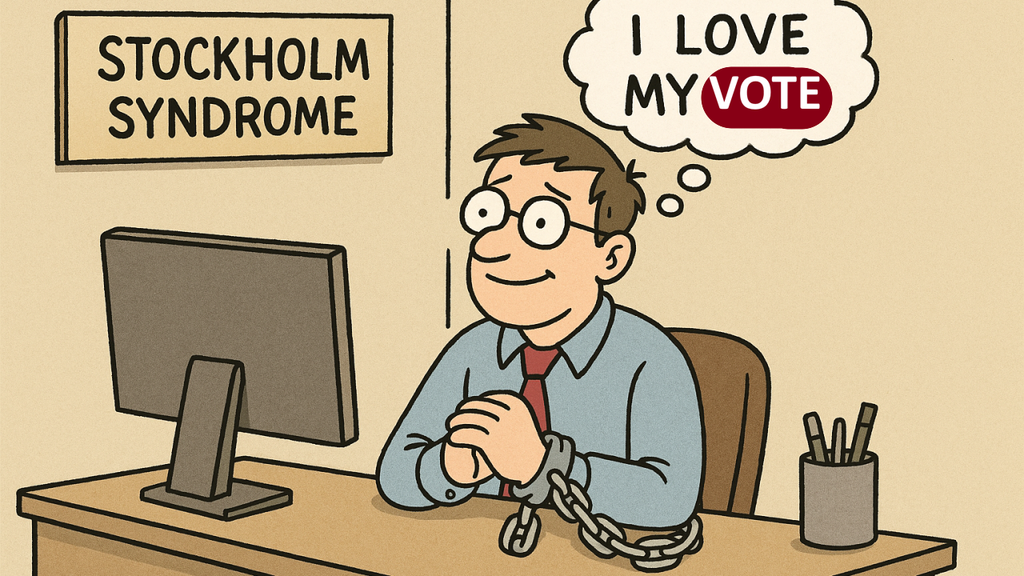
The United States is suffering from electoral Stockholm Syndrome.
Our competitive nature is destroying us. They know exactly how to weaponize that.
For those deeply involved in American politics, elections are just as much about pageantry as they are about policy. Some don’t care about policy at all, instead seeing politics as a team sport, and a contact one, at that. Primary voters, those who select the candidates for lower-propsensity voters in the general election, try to pull the parties in opposing directions, and as far as they can.
The result is candidates who try to please everyone all of the time, and wind up pleasing nobody. Ultimately, they simply have to be less offensive than their general election opponents.
And in a general, Americans sure do love a winner. The clearer the winner, the better. Oftentimes, it doesn’t matter to anyone how they got there. They don’t even care if they harm themselves in the process, as long as nobody remembers second place. Enter: first-past-the-post (FPTP) voting.
Duverger’s Law is a political science principle stating that single-member electoral districts using plurality FPTP voting naturally tend to favor a two-party system. Thus, the first step to creating space for additional parties and their ideas is to demand preference voting.
Until we do, we will always be caught between the same two top-down parties with the same tired ideas, repeatedly making the same mistakes. We have removed their incentive to adapt. Clowns to the left of me, jokers to the right.
When we look at how we build a truly accountable society based on individual rights, we have to re-evaluate how power is derived. Preference voting systems fundamentally change how elections are conducted, expanding options, and making primary elections obsolete.
By voting NOTA whenever your conscience won’t allow you to vote for the candidates presented, you voice your dissatisfaction without skipping the election and penalizing the candidates you do support. In New Hampshire, undervotes, or incomplete ballots, are counted. However, a blank line doesn’t make a statement.
NOTA makes a statement.
Approval voting should be the answer.
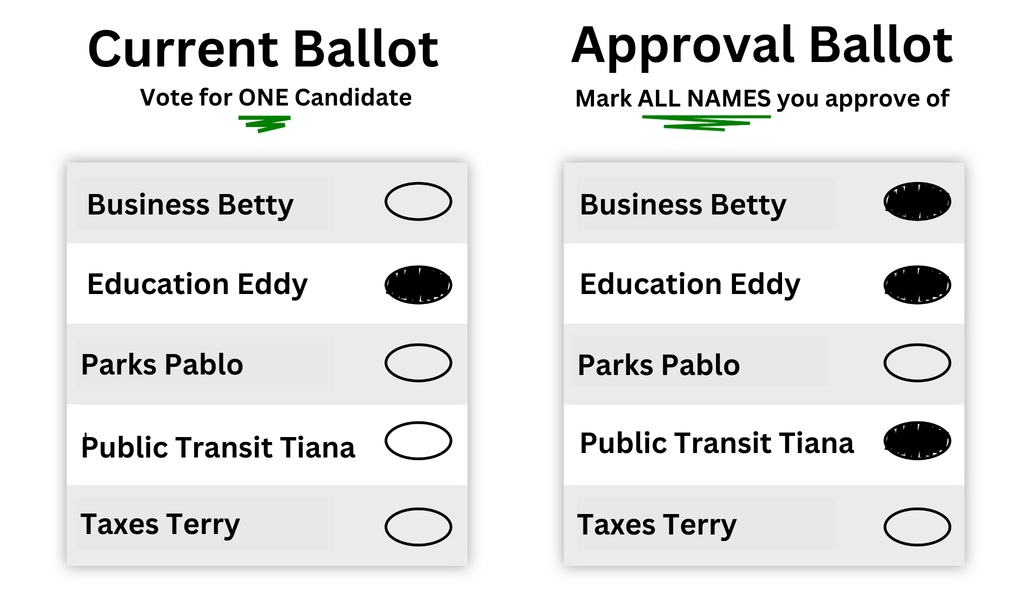
Approval Voting. It is, without a doubt, the most elegant, human-first reform we could bring to elections in New Hampshire. It requires no new instructions to voters. It is tallied using the count system already in place. It confers more specific consent of the governed. It creates space for a marketplace of ideas.
Most importantly, it overcomes the objections of state politicians who reject Ranked-Choice Voting due to its technical complexity.
Here is why Approval Voting is a simplistically sophisticated amplifier of voluntary cooperation and individual choice:
- Vote for as Many as You Approve Of: The ballot looks exactly like the one you use right now. There are no complicated ranking grids or number systems. The only difference is the instructions change from “Vote for one” to “Vote for one or more.” If there are three candidates on the ballot you genuinely like, you simply check the box next to all three. “Why not both? Or more?”
- No more guilt-trips over the “Spoiler Effect”: In a FPTP election, voting for a principled independent candidate is mocked as “wasting your vote.” Approval Voting completely destroys this sociological pressure instilled and protected by the duopoly. You can cast a vote for your favorite third-party or independent candidate and cast a vote for a major-party candidate. Take that, peer pressure!
- The Math is Clean: There are no elimination rounds, no complex formulas, and no computers to add to New Hampshire’s tech stack. Every checkmark counts as a vote. Election officials simply add up the total number of checkmarks each candidate received, and the person with the most wins. It is completely transparent, accountable, and flawlessly compatible with hand-counting.
Ultimately, Approval Voting takes power out of the hands of gatekeeping party bosses and gives it back to candidates and voters. It allows a diverse marketplace of ideas to flourish, ensuring that whoever wins a seat actually earns the consent of the governed.
Well, for the most part. 🗽